

Health care institutions require effective sterilization in order to ensure that there are no harmful microorganisms for patients, health care practitioners, and the health care setting. Although steam sterilization has been largely employed, not all instruments and items can withstand exposure to heat and moisture. In such cases, ETO sterilization has come into use.
ETO sterilization is a low-temperature method that is suitable for use on a variety of medical instruments, especially those made up of heat sensitive materials such as plastics, polymers, and glass. This is because of its ability to pass through the packaging and complicated surfaces within the instrument.
Why ETO Sterilization Matters in Healthcare
Medical devices are becoming more sophisticated. The catheter, the tube, the packed medical device, the electronic component, and the polymer-based products may not be appropriate to undergo sterilization through steam process.
ETO provides an alternative by using gas at controlled conditions and relatively low temperatures. This allows manufacturers and healthcare facilities to sterilize products without exposing temperature-sensitive components to the conditions associated with steam-based processes.
The process can also penetrate packaging and difficult-to-access areas of certain devices, making it particularly useful where conventional sterilization methods may have limitations.
Supporting Heat-Sensitive Medical Products
One of the biggest advantages of ETO sterilization is its suitability for products that could be damaged by heat or moisture.
Medical devices may contain plastic components, multiple layers of packaging, narrow passages, or intricate structures. A properly controlled ETO cycle can help address these challenges while maintaining the integrity of the product.
For healthcare and medical-device manufacturers, this means sterilization can be incorporated into production processes without unnecessarily compromising the performance or physical properties of sensitive products.
A Controlled Approach to Sterilization
ETO sterilization is not simply about exposing products to gas. It involves a carefully controlled cycle in which critical parameters such as temperature, humidity, pressure, exposure, evacuation, and aeration need to be managed appropriately.
A typical ETO cycle includes stages such as preconditioning or humidification, gas introduction, exposure, evacuation, and air washes. Aeration is also important after the sterilization stage to allow residual ETO to be removed from the treated products.
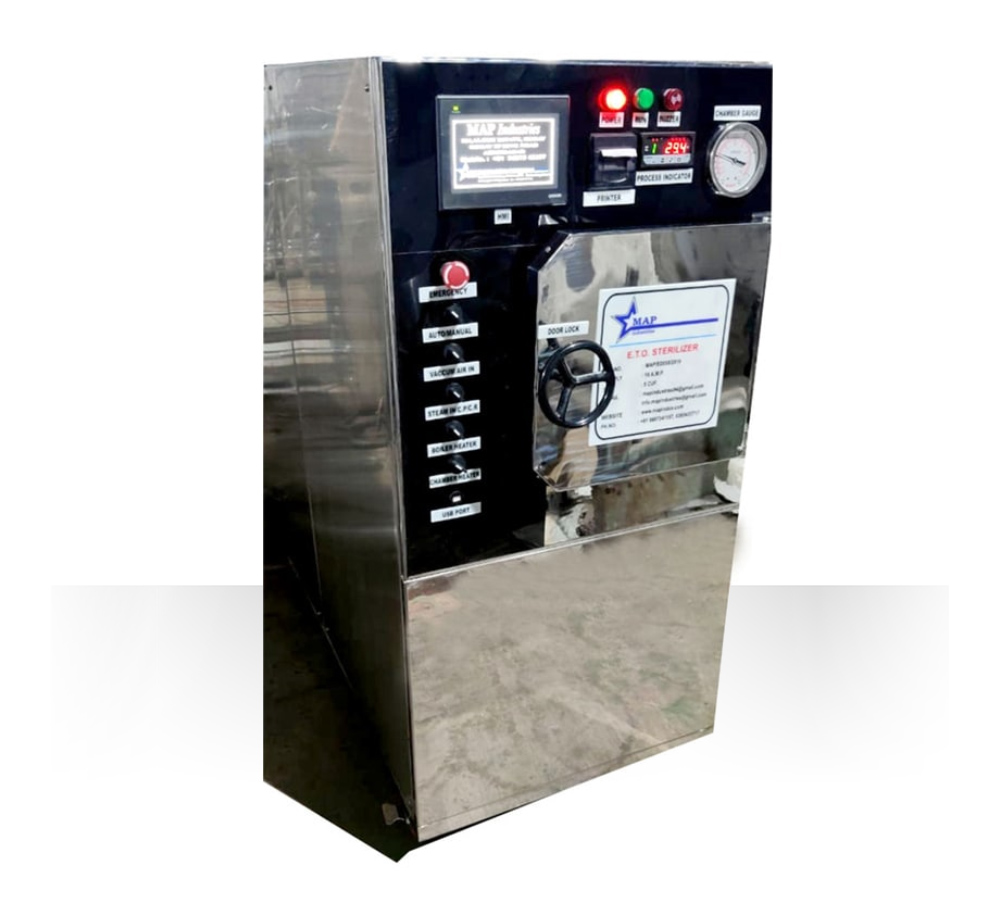
Modern systems can improve control over these stages through automation. For example, MAP Industries’ automatic ETO sterilizers feature PLC-based automation, programmed sterilization cycles, automatic aeration, and monitoring of parameters including temperature, pressure, and humidity.
Safety Is a Critical Part of ETO Sterilization
Although ETO offers important sterilization benefits, the gas requires careful handling because of its hazardous properties. Therefore, equipment design, process controls, monitoring, ventilation, leak detection, and appropriate safety measures are essential.
Modern ETO sterilization systems incorporate safety features designed to help control the process. MAP Industries’ systems, for example, include controlled cartridge puncturing conditions, heavy-duty stainless-steel chambers, insulation, and password protection to help prevent unauthorised access.
For healthcare facilities and manufacturers, choosing equipment with appropriate safety and monitoring systems is therefore as important as considering sterilization performance.
The Role of Automation in Modern ETO Systems
Automation is changing how sterilization processes are managed. Manual monitoring of multiple parameters can increase the possibility of inconsistency, whereas automated systems can help operators maintain defined process conditions.
PLC-based systems can provide programmed cycles while displaying current and set values for important parameters. Reporting capabilities can also support process documentation and operational monitoring.
This combination of automation and controlled processing can make ETO sterilization more practical for facilities that require repeatable and monitored sterilization cycles.
Choosing the Right ETO Sterilization Equipment
Selecting an ETO sterilizer requires more than comparing chamber dimensions or equipment prices. Healthcare facilities should consider the types of products being sterilized, required capacity, process requirements, automation, safety provisions, monitoring capabilities, and after-sales support.
The equipment should also be appropriate for the intended application and designed around the facility’s operational requirements.
As an established ETO sterilizer manufacturer in Ahmedabad, MAP Industries provides automatic ETO sterilization solutions for healthcare and industrial applications. Its systems are designed with controlled temperature, humidity, vacuum and other critical parameters, along with automated cycle and aeration functions.
Looking Ahead
As medical devices continue to evolve, sterilization technologies will need to accommodate increasingly complex materials, packaging formats, and device designs. ETO sterilization is likely to remain relevant where low-temperature processing and gas penetration provide advantages over conventional methods.
The future of healthcare sterilization will increasingly depend on a combination of effective technology, process control, safety, automation, and consistent validation. ETO systems that bring these elements together can support the growing requirements of hospitals, medical-device manufacturers, pharmaceutical organisations, and other healthcare-related facilities.
Conclusion
ETO sterilization has become an important part of modern healthcare because it provides a low-temperature option for products that may not be suitable for conventional high-temperature sterilization. With the right equipment, controlled processing, automation, and safety measures, it can support reliable sterilization across a wide range of applications. MAP Industries offers automatic ETO sterilizer solutions designed around controlled operation, monitoring, safety, and process efficiency. If you are evaluating ETO sterilization equipment for your healthcare or industrial requirements, connect with MAP Industries to discuss a suitable solution for your application.
FAQs
ETO sterilization uses ethylene oxide gas to eliminate microorganisms from medical devices and other products, particularly those that may not withstand high-temperature sterilization.
ETO can penetrate packaging and complex areas of certain devices while operating at relatively low temperatures, making it suitable for many heat- and moisture-sensitive products.
Yes. ETO sterilization can be used for appropriate medical products and devices where conventional sterilization methods may not be suitable.
Capacity, product type, temperature and humidity control, automation, safety systems, aeration, monitoring, and process requirements should all be considered.
Automation helps control critical process parameters and can provide programmed cycles, monitoring, reporting, and automated aeration for more consistent operation.